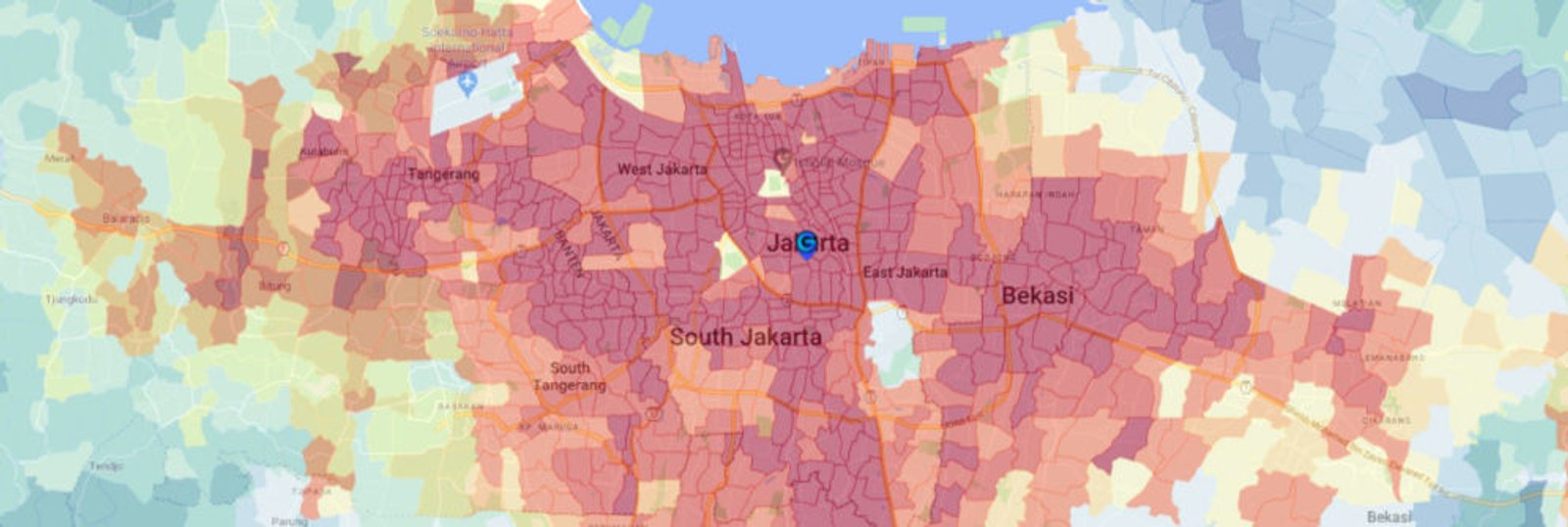
The short answer. GapMaps is a cloud-based location intelligence platform used by franchise operators, investment groups and holding companies to decide where to open — and where not to. It is not a food or fitness unit franchise; it is the analytical layer that sits underneath those rollouts. A GapMaps franchise use case typically starts the moment an operator signs territory rights and has to convert a map into a credible site pipeline. VF Franchise Consulting is the exclusive representative of GapMaps across Asia, and access is published on VF’s brand page at an investment level of US$15,000.
Most cross-border franchise deals in Asia Pacific and MENA fail or stall for one of two reasons: the wrong partner, or the wrong sites. The partner question is a diligence exercise. The site question is a data exercise — and in most of the region, the data has historically been bad.
A master franchisee who commits to a multi-year development schedule is effectively promising to find a specific number of viable trade areas inside a specific territory. If the population, worker density and competitor picture are guesses, that schedule is a guess too. This is why site validation now sits inside the diligence phase rather than after signature, a shift we cover in our guide to master franchise, area development and single-unit structures.
GapMaps Live is a cloud platform that lets a team visualise its own data alongside curated location intelligence datasets. The stated design principle is that you do not need mapping expertise to use it — it is built for operators and development directors, not GIS specialists.
The core capabilities break down as follows:
The datasets curated across Southeast Asia include household demographics, latest resident population estimates, latest worker population estimates and consuming-class estimates. The worker-population layer is the one operators tend to underrate: a CBD trade area that looks thin on residents can be extremely strong on daytime workers, and a lunch-led format lives or dies on that distinction.
Rather than treating the platform as a map, it is more useful to treat it as a sequence of decisions a developing operator has to make. The table below maps that sequence — it is a decision framework, not a cost model.
| Expansion stage | The question on the table | Data layer that answers it |
|---|---|---|
| Pre-signature diligence | How many viable trade areas does this territory actually contain? | Resident and worker population estimates, consuming class |
| Territory carve-up | Where do sub-territory or sub-franchise boundaries fall fairly? | Catchment modelling by drive time, POI density |
| Pipeline build | Which cities come first, second and third? | Household demographics, competitor footprint |
| Individual site approval | Does this specific unit have the catchment to support the format? | Freeform or walk-time catchment, granular grid data |
| Cannibalisation check | Will this site erode an existing one? | Overlapping catchments, own-network layer |
| Competitive response | Who else has moved into this trade area? | Competitor and reference brand mapping |
Coverage is the reason this matters for cross-border investors. Through VF, GapMaps is available across 23 markets: Australia, Bahrain, Bangladesh, Brunei, Cambodia, Hong Kong, India, Indonesia, Japan, Korea, Kuwait, Laos, Malaysia, Myanmar, Nepal, Oman, Pakistan, Qatar, Saudi Arabia, Sri Lanka, Taiwan, the United Arab Emirates and Vietnam.
That footprint maps almost exactly onto the territories where international brands are currently awarding development rights. An operator weighing Indonesia against Vietnam against Saudi Arabia can run all three on the same data model rather than three incompatible local studies.
The platform’s positioning is explicitly aimed at markets where official statistics are thin. Pat McMichael, Group MD and CEO of Eat’n’Go Ltd, put the point directly:
“GapMaps has a unique ability to create high quality location intelligence data and insights in some very data-challenged countries. The quality of their data and simple to use platform has enabled me to introduce world class market and network planning processes to businesses where network planning had previously been quite rudimentary.”
That is the practical value for a franchisee in a frontier or fast-urbanising market: the alternative is not better data, it is instinct.
Mayank Bhatia, Regional Franchise Sales Manager at Anytime Fitness, described using the platform to analyse catchments across multiple Indian cities and approve gym locations against validated data — accessing population density, prosperity, retail and infrastructure layers at 150-metre grid resolution, which he credited with fast-tracking the approval process for planned new sites.
Grid resolution is the detail worth noting. At 150 metres, the analysis distinguishes between two sides of an arterial road — a difference that decides a studio’s membership catchment. Operators evaluating fitness and boutique studio opportunities across Asia Pacific face exactly this granularity problem, as do those in coffee and restaurant formats, where a hundred metres changes the trade area entirely.
GapMaps fits a specific profile rather than a general one:
It is less relevant to a single-unit owner-operator with one location already secured. The value compounds with the number of decisions being made.
GapMaps reports being trusted by over 500 brands in more than 23 countries. Full platform details are on the GapMaps corporate site.
No. GapMaps is a location intelligence platform, not a unit-based retail or food franchise. Franchise operators use it as a decision tool across their network. VF publishes an investment level for access on the GapMaps brand page.
Standard mapping shows you geography. GapMaps layers curated demographic, worker, consuming-class and competitor datasets on top of that geography, and lets you overlay your own performance data — so the output is a commercial judgement rather than a picture.
That is the stated design intent. The platform’s data team curates, checks and updates resident and worker population estimates down to a granular level specifically for markets where official statistics are limited.
The point-of-interest database spans multiple sectors including quick service restaurants, cafés and supermarkets, with thousands of brands tracked. It is used across food, fitness, childcare, retail and services networks.
VF Franchise Consulting is the exclusive representative of GapMaps across Asia, delivering the platform to franchise operators, investment groups and holding companies for territory planning and expansion strategy. That sits alongside VF’s wider cross-border franchise advisory work and its non-food service brand portfolio.
Territory planning is the least glamorous part of a franchise deal and the part that most reliably determines whether the schedule gets met. Getting the map right before the ink dries is simply cheaper than correcting it afterwards.