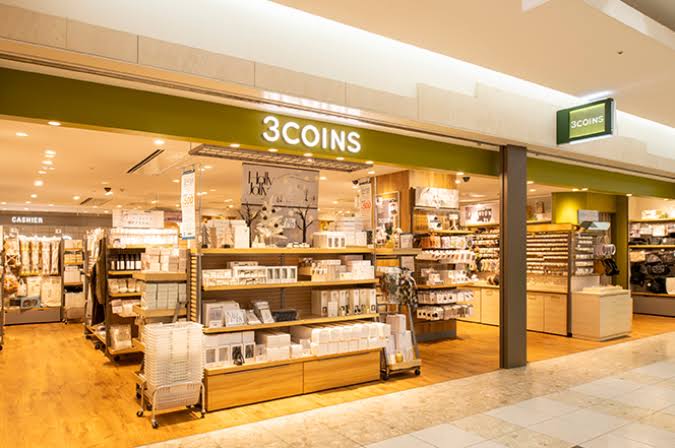
3Coins has opened its first store in Taiwan, a 370-square-metre unit inside Eslite Spectrum Wuchang in Taipei’s Ximending district. The launch is run not by the Japanese owner directly but through a two-layer structure: Hong Kong-based Yaichi Group holds the master franchise for the brand outside Japan, and has brought in a local operating partner to run Taiwan.
Parent company PAL Group does not take 3Coins abroad on its own balance sheet. It appoints Yaichi Group as master franchisee, and Yaichi then assembles the market-level partnership. For Taiwan, Yaichi paired with FullSynergy New Retail, the e-commerce arm of telecom carrier Taiwan Mobile Group.
That structure matters more than the single storefront. It lets a Japanese brand with 80.94 billion yen (US$523 million) in annual brand sales — the figure for the year ended February — enter a market without building a local corporate entity, hiring a country team, or carrying the property risk itself. It is the same logic behind Iris Galerie handing India to a master franchise partner rather than opening directly.
Their joint model pairs physical department store space with a dedicated online store.
FullSynergy handles local operations, digital marketing, and loyalty integration across Taiwan Mobile’s existing customer base. For an imported retail concept, that is a shortcut past the hardest part of market entry.
Most foreign brick-and-mortar brands arriving in a new Asian market spend two to three years assembling what a carrier already owns: a customer file, a payments rail, a loyalty programme, and a reason for a shopper to come back a second time. Pairing a department-store site with a dedicated online store from day one collapses that runway.
Taiwan has a proven appetite for Japanese discount and variety retail — which is precisely why central Taipei is contested. Daiso, Don Don Donki and Nitori already hold prime sites across major transit corridors and shopping malls. Choosing Ximending puts 3Coins in front of young shoppers and tourists rather than a suburban catchment where footfall has to be manufactured. The same site-quality question decides outcomes for first international units in Singapore mall locations.
The Taipei opening follows 3Coins’ first overseas move into Hong Kong last year, where Yaichi also runs the store network. That sequencing — one market proven, the same master franchisee extended into the next — is the standard pattern for Asian regional rollouts, and it is why the identity of the master partner tends to determine the pace of everything that follows. It is a pattern repeating across Japanese brands exporting into Southeast Asia and the Gulf.
Three things are worth extracting for anyone evaluating a master franchise or country development agreement.
First, the sub-partnering model is doing real work here. A regional master franchisee that can recruit a credible local operator in each market is worth substantially more to a franchisor than one that intends to operate everything itself — and franchisors increasingly price that capability into who they award rights to.
Second, the choice of local partner is now as much about data and distribution as about retail experience. A telecom carrier, a bank, a mall landlord or a large e-commerce platform brings a customer graph that a pure retail operator does not. In Southeast Asia and the Gulf, where conglomerates are actively hunting consumer-facing assets, that pairing is increasingly available to brands that ask for it — as the wave of Korean brands moving into ASEAN and the GCC has shown.
Third, the variety-retail category itself is worth watching. PAL Group’s variety division grew 14% while its legacy apparel business lagged — a reminder that low-ticket, high-frequency formats travel across borders more easily than fashion, and that they fit the smaller footprints landlords across ASEAN and MENA are willing to release.
The open question is scalability. A single flagship in a tourist district proves demand; it does not prove a unit model. Yaichi and FullSynergy now have to make the format work in New Taipei, Taichung and Kaohsiung, where the footfall is domestic and the rent-to-sales maths is less forgiving.
Source: RetailNews Asia — 3Coins Debuts in Taiwan with 370-Square-Metre Store in Taipei