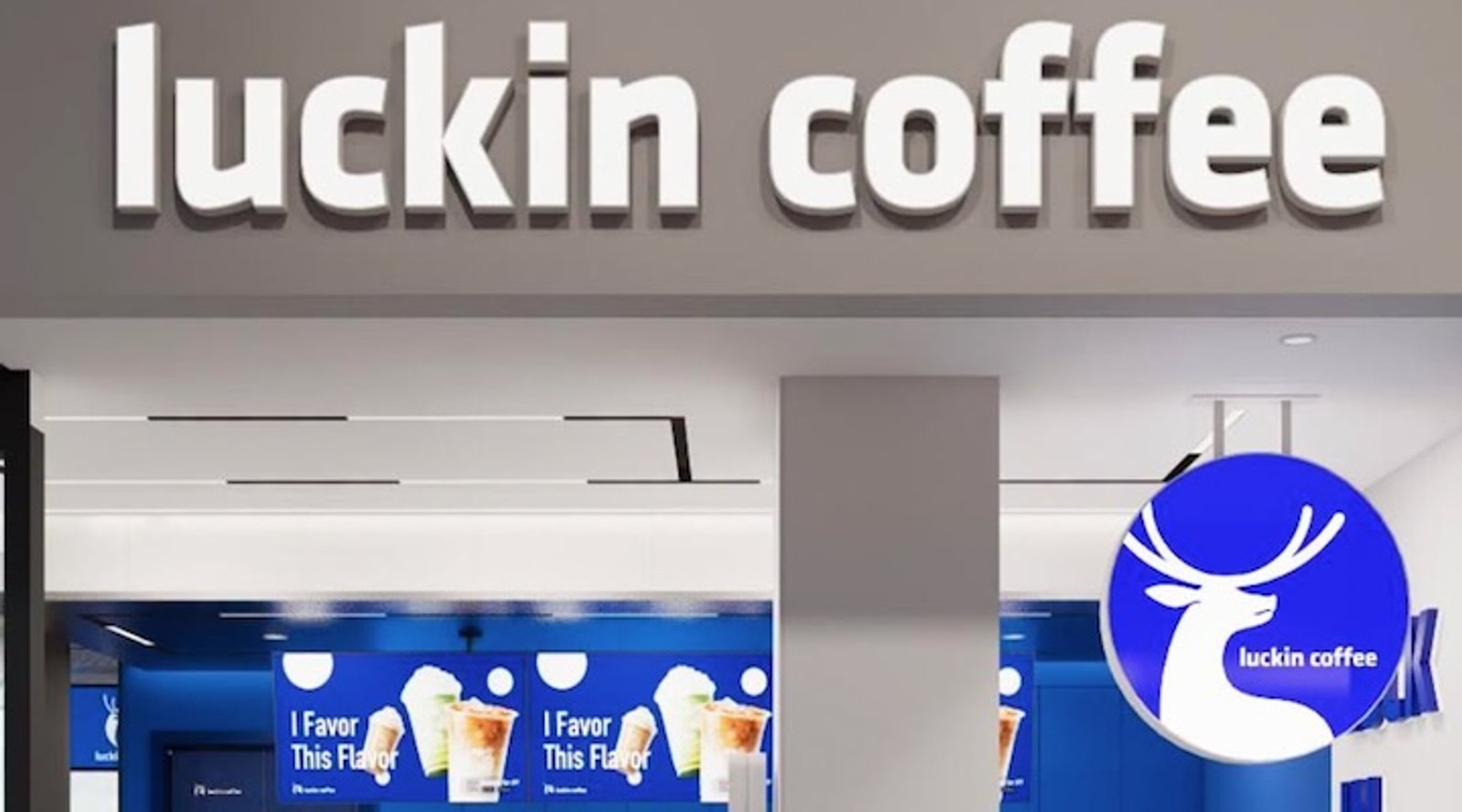
Luckin Coffee has opened its 100th store in Singapore, three years after the city-state became the Chinese chain’s first market outside mainland China. The new outlet sits in Bugis, one of Singapore’s busiest transport and commercial nodes, and the company now describes itself as the country’s second-largest coffee chain by store count. For investors tracking how Chinese F&B brands are scaling across Asia Pacific, the milestone is a useful data point on speed, format and capital.
Luckin entered Singapore in 2023. According to Inside Retail Asia, the brand says it has since served more than 1.9 million cumulative transacting customers in the market. Its network now covers commercial districts, residential neighbourhoods, transport hubs, hospitals and university campuses, a spread that reflects a deliberate plan to sit inside daily routines rather than compete only for weekend or leisure traffic.
Industry coverage by Franchise TV puts the 100-store count at roughly 70 percent of Starbucks’ estimated 140-store network in Singapore.
The growth has leaned on kiosk-style and small-footprint stores paired with app-based ordering and promotional vouchers, the same playbook that powered the brand’s rise in China. Small boxes lower fit-out requirements and make it easier to secure sites in office towers, MRT-linked malls and hospital lobbies, where rent per square metre is high but footfall is dependable.
Luckin chairman David Li credited the result to adapting the brand’s digital capabilities, product development and supply chain to local conditions.
“Singapore also proves that our model travels well.” — David Li, Chairman, Luckin Coffee
That message matters beyond Singapore. The company followed its Singapore entry with a Malaysian rollout, including three outlets in Johor Bahru, and it also operates stores in the United States.
The Singapore milestone lands shortly after Abu Dhabi sovereign investor Mubadala agreed to take a significant minority stake in Luckin valued at approximately US$1 billion, alongside existing shareholder Centurium Capital. VF covered that transaction in detail in Mubadala’s US$1 billion bet on Luckin Coffee. Institutional backing of that size gives the brand room to keep opening at pace in high-rent markets.
Singapore is often used as a test market for Southeast Asia, and the coffee category there is now crowded at every price point: global chains, Chinese challengers, homegrown kopi brands and specialty roasters. The ownership shake-up at Starbucks’ regional operator, covered in our report on DFI Retail taking sole control of 1,100 Starbucks coffeehouses, shows the incumbents are reorganising at the same time.
Analysts quoted in regional coverage expect the next phase to turn on repeat purchase frequency and how the small-format model performs at standard pricing. That is the question any operator weighing a coffee concept in the region will want answered, and it is one reason the category remains one of the most active in our tracking of coffee franchise opportunities in Asia Pacific.
Three points stand out for master franchisees, multi-unit operators and family offices assessing beverage concepts. First, density beats flagships: 100 small units in three years built brand visibility faster than a handful of large cafés would have. Second, the technology stack travelled with the brand, so ordering, loyalty and data were in place from day one rather than retrofitted by a local partner. Third, the brand used one market to prove the model before pushing further, and the customer data it now holds from Singapore will inform how it approaches the next set of countries.
For brands planning their own Singapore entry, the regulatory and structural options are set out in our guide to franchising in Singapore in 2026. For investors in the GCC, where Mubadala’s involvement has raised the brand’s profile, the Singapore numbers are an early indicator of what a dense, app-led coffee network can achieve in a high-cost city.
Source: Inside Retail Asia — Luckin Coffee reaches 100-store milestone in Singapore