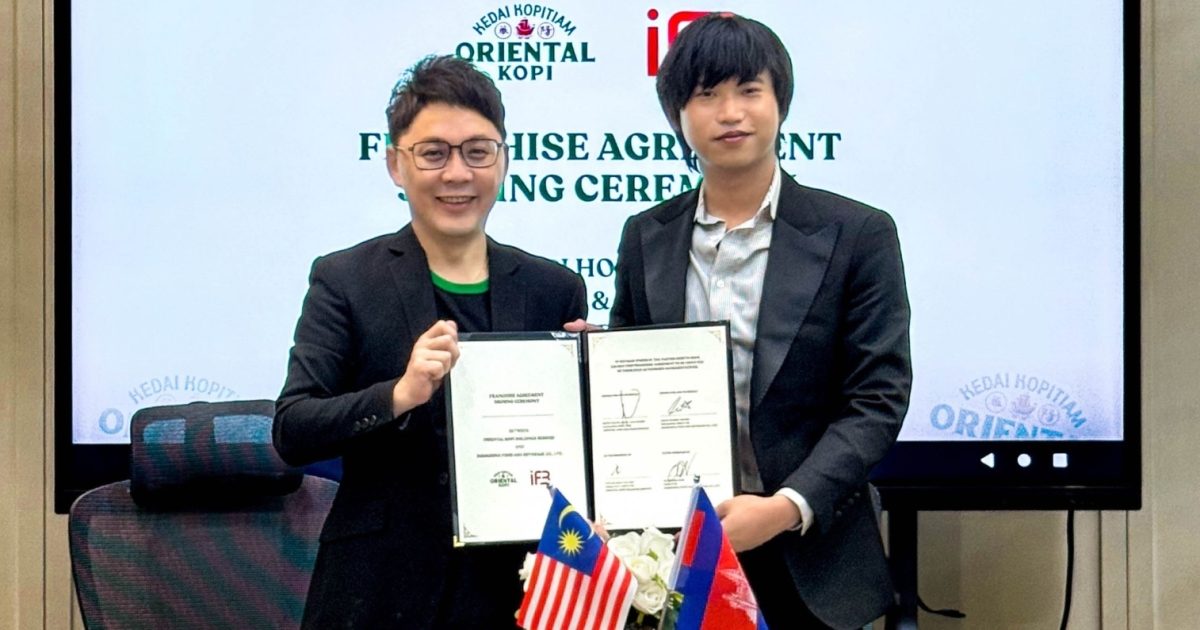
Oriental Kopi Holdings Berhad, the Malaysian kopitiam-style café group, has signed a territory franchise agreement that takes the Oriental Kopi brand into Cambodia. The local partner is Indochina Food and Beverage Co., Ltd., which receives exclusive rights to develop and operate Oriental Kopi cafés across the country, with the first outlet planned for Phnom Penh. QSR Media Asia reported the deal on 24 November 2026.
The rights were granted by Oriental Coffee International Sdn. Bhd., an indirect wholly-owned subsidiary of the listed group. The structure is a single-partner territory franchise rather than a joint venture: Indochina Food and Beverage carries the capital and the operating load, while the brand owner supplies the system.
According to the report, Indochina will pay a franchise fee and monthly royalties for each café it runs. The terms were not disclosed.
The first café will open in Phnom Penh.
Expansion into other Cambodian cities will be considered later. The group told the market it does not expect the agreement to have a material effect on earnings per share, gearing or net assets for the financial year ending 30 September 2027, though it expects a positive contribution to future earnings.
Cambodia follows a run of market entries over the past year. Oriental Kopi currently operates three cafés in Singapore. In August 2026, the group also secured entry into Indonesia through a joint venture with Erajaya Group, and into Mauritius through a territory franchise agreement with Coffee Time Ltd.
The mix of structures is worth noting. Indonesia, a large and complex market, went to a joint venture with an established conglomerate. Mauritius and now Cambodia, smaller markets, went to territory franchisees. That is a common pattern for Malaysian and Singaporean F&B brands moving through ASEAN, and it mirrors the routes VF compares in its guide to master franchise, area development and joint venture structures.
QSR Media Asia notes that Cambodia has a population of roughly 17 million, and that coffee shops have become part of the daily routine for younger consumers, including students and young professionals. A Malaysian kopitiam concept, built around local-style coffee and familiar comfort food, sits between street vendors and international specialty chains on price and positioning.
Phnom Penh is the natural first site: it concentrates office workers, malls and the urban middle class. For investors weighing the market more broadly, VF’s Cambodia franchise market guide covers entry structures and the sectors drawing foreign brands.
Three points stand out for operators and family offices watching ASEAN F&B.
First, Malaysian café brands are now exporting actively. Oriental Kopi joins other Malaysian and regional names, such as Viva Star Coffee’s overseas rollout, in using franchise partners to reach neighbouring markets quickly. Second, the 365-day opening deadline and the five-year renewable term show brand owners asking for fast proof of concept before committing to a wider territory. Third, the partner’s role in site selection puts the real estate decision squarely on the local operator, so property access is a core qualification for anyone seeking similar rights.
For a wider view of the category, see VF’s overview of coffee and tea franchise formats across Asia Pacific and MENA.
Source: QSR Media Asia — Oriental Kopi enters Cambodia through franchise agreement