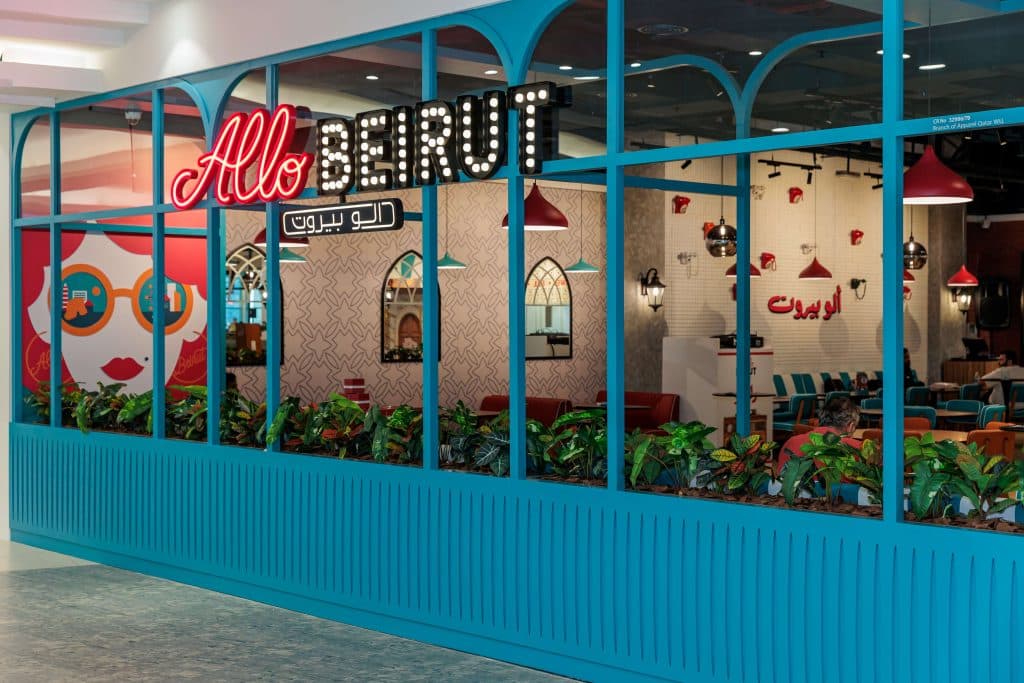
Allo Beirut, the Lebanese street-food brand founded in Dubai in 2018, has crossed into Iraq for the first time, opening a restaurant in Baghdad’s Zayouna district through a franchise partnership with a local operator. The move lands in a year that has already produced five new GCC openings for the brand, and it takes owner Prime Blackspoon Holdings into a seventh market as the group marks eight years of trading.
The Zayouna opening arrived in July and was structured as a franchise partnership rather than a direct investment. Zayouna is one of Baghdad’s denser restaurant, retail and fashion districts, which makes it a conventional first-site choice for a brand testing a new country: high ambient footfall, an established dining habit, and neighbours who have already proved the catchment.
What matters to anyone watching cross-border deal structures is the division of labour. Prime Blackspoon keeps the brand, the menu architecture and the service model. The Iraqi partner supplies what a foreign franchisor cannot buy quickly — real estate relationships, import and supply knowledge, and staffing networks inside a market that rewards local fluency. That is the standard shape of a workable country-entry deal, and it is the same logic we set out in our guide to choosing between master franchise, area development and joint venture structures.
The Iraq debut sits inside a much broader 2026 rollout. Allo Beirut’s development across the Gulf runs largely through Prime Blackspoon Holdings’ franchise agreement with Apparel Group, the regional retail and lifestyle conglomerate. That partnership, signed in 2024, has now produced 13 Allo Beirut locations across the Gulf, five of them opened this year.
Read as a sequence, the pattern is deliberate. Saudi Arabia is being densified rather than merely entered — six restaurants in Riyadh and Jeddah before the brand pushed hard into adjacent markets. Oman, Qatar and Iraq were then added one site at a time. The brand now trades across the UAE, Saudi Arabia, Oman, Bahrain, Qatar and Iraq.
Allo Beirut is a useful illustration of a wider habit in the region: successful UAE-born concepts scaling outward through franchise agreements with established regional groups instead of building country subsidiaries. The appeal is straightforward. A partner like Apparel Group brings mall relationships, a leasing track record and supply-chain depth that would take a brand owner years and considerable capital to replicate — while the franchisor retains control of identity, menu and service standards.
Gulf retail conglomerates have made this a repeatable playbook. Alshaya Group is running the same model for European retail, as our coverage of Primark’s Bahrain and Qatar rollout showed, and Americana Restaurants applied it in food service when it brought Taco Bell back to the UAE under an exclusive Gulf development deal.
“A strong brand is built through consistency, but sustained growth comes from continuous evolution.”
That line came from Gabi Al Far, group chief financial officer and interim group chief executive of Prime Blackspoon Holdings, who added that the company was “delighted to welcome our new franchise partner in Baghdad to the Allo Beirut family.” He credited both customers and franchise partners with shaping the group’s growth, and framed the next phase around new benchmarks in service, food quality and hospitality.
The commercial signal here is not the single Baghdad site. It is that Lebanese dining formats built in the UAE are now travelling as franchise systems in their own right. Allo Beirut has evolved from one Dubai restaurant in 2018 into a six-country network, and the brand is simultaneously refreshing its original UAE estate — a sign the franchisor understands that an ageing home market undermines the proposition it is selling abroad.
Other regional operators are running the same play. Kuwait’s Lebanese grilled-chicken specialist is opening territory rights across the region, as covered in our profile of the Farouj Abo El Abd franchise model, while Dubai-born Pickl has been weighing Singapore and Hong Kong for its Asia entry. The direction of travel is consistent: concepts proven in Gulf conditions are increasingly viewed as export-ready systems rather than local restaurant chains.
For family offices and multi-unit operators assessing MENA F&B, three things in this deal are worth underlining. First, Iraq is being opened by a mid-sized regional franchisor rather than a global QSR system — an early-mover signal about where GCC operators believe the next demand sits. Second, the Apparel Group agreement shows that a single well-chosen regional partner can substitute for six separate country negotiations, which materially compresses rollout time. Third, the brand is expanding while renovating, which is the discipline that separates systems that survive a second decade from those that stall after the land-grab.
Investors evaluating comparable opportunities should look closely at how much territory a regional conglomerate has locked up before assuming a market is available. The more attractive the concept, the earlier those rights tend to be committed — a dynamic we unpack in our overview of franchise entry routes and ownership structures in Dubai and the UAE. Brands at Allo Beirut’s stage, seven or eight years in and newly multi-country, are typically the last window for genuinely open territory before a category leader consolidates the map.
Further detail on the brand’s partnership programme is published on the company’s own Allo Beirut franchising page.
Source: Arabian Business — Dubai-born Allo Beirut expands into Iraq as GCC growth accelerates