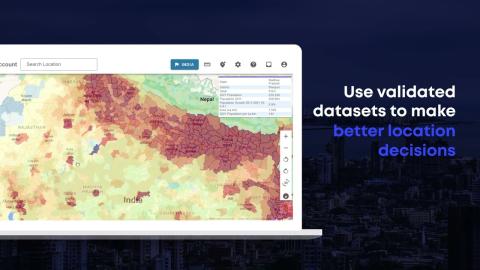
GapMaps is the cloud-based location intelligence platform that an increasing share of master franchisees in Asia and MENA use to take the guesswork out of new-market site selection. With coverage of over 1.6 billion mobile devices across 44 countries and pre-built datasets covering QSR, retail, fitness, childcare and healthcare, GapMaps Live lets multi-unit operators rank candidate trade areas in hours rather than the 6 to 12 months a traditional consulting engagement requires. This guide walks through how the platform actually works for franchise site selection, what GapMaps pricing typically looks like, where its data is strongest in Asia and MENA, and how it compares to GapMaps competitors like CARTO, Mapbox and Galigeo.
GapMaps is a Sydney-headquartered SaaS platform that combines GIS mapping, demographic data, mobility data and competitor brand location data into a single browser-based interface called GapMaps Live. The company tracks thousands of brands and millions of points of interest globally — meaning a master franchisee can drop a candidate site onto the map and instantly see daypart visit volumes, competitor density, demographic match scores and territory cannibalization risk against existing stores.
The customer base spans QSR (Domino’s, KFC, Starbucks, Burger King, Subway, McDonald’s all appear as reference brands inside the platform), boutique fitness, supermarkets, childcare, petrol stations and aged care. In April 2026 the company appointed Peter Holmes as CEO to lead global expansion across Asia, MENA and the Americas — a clear signal that emerging franchise markets are the next priority for the platform.
The site selection workflow inside GapMaps Live follows four steps that map directly onto how master franchisees actually evaluate territory:
“Location opportunities are scored and ranked according to how closely they match your existing high performing locations.”
The pattern Nando’s documented across Asia using GapMaps — a 40% reduction in expansion planning time — is typical. The savings come from compressing two activities that normally run sequentially: the third-party demographic data buy (often 6–10 weeks), and the manual cross-mapping against competitor footprints (another 6–10 weeks). Both happen inside the platform, in real time.
Five capabilities matter most for international master franchise development plans:
Geographic coverage matters more for a master franchisee than feature count. GapMaps’ strongest data depth sits in Australia, New Zealand, Southeast Asia, the GCC (especially Saudi Arabia and the UAE), Hong Kong and selected North American markets. Vietnam, the Philippines and Indonesia have working — but thinner — datasets, which means a master franchisee in those markets typically combines GapMaps with one or two local-data partners on the platform’s Data Marketplace. For Saudi Arabia and the UAE, the addition of Panolytica’s segmentation grid in 2026 has materially closed the data gap versus what’s available in mature Western markets.
| Platform | Strength | Best Fit For | Pricing Model |
|---|---|---|---|
| GapMaps Live | Pre-built brand POI tracking + mobility data + GapFinder white-space tool | Multi-unit franchisees and franchisors with 5–500+ stores planning expansion | Custom annual fee, ~US$15K starting |
| CARTO | Cloud-native GIS analytics on top of Snowflake/BigQuery | Enterprise data teams that already own warehouse infrastructure | Tiered SaaS, mid-five to six figures |
| Mapbox | Developer-grade mapping APIs and customizable visualization | Engineering teams building custom location features into apps | Pay-as-you-go API calls |
| Galigeo | Embedded mapping inside BI tools (Tableau, Power BI, SAP) | BI-led organizations that want maps inside existing dashboards | Per-seat enterprise license |
For a master franchisee whose primary need is “rank these 50 candidate sites in Riyadh by likely first-year sales,” GapMaps is the most plug-and-play option of the four. CARTO and Mapbox demand engineering resources; Galigeo demands an existing BI deployment. GapMaps ships with the franchise-specific datasets and analytic templates already in place.
GapMaps does not publish a fixed price list. Annual fees are scoped to the value derived — an enterprise client managing 10,000+ locations pays differently from a 10-store master franchisee. The starting point referenced in third-party directories is around US$15,000 per year for a single-country, single-brand subscription with standard data packages, scaling up based on country count, sector breadth and team size. A free GapMaps demo is available, and the company tailors the data and mapping bundle to each engagement. Investors evaluating the platform should request a pricing proposal scoped specifically to the country count and store count in their development plan, rather than relying on directory-level estimates.
For a master franchisee committing to a 30 to 100-store development schedule across a market like Saudi Arabia, the UAE, Vietnam, the Philippines or Indonesia, the core question is whether the cost of GapMaps is dwarfed by the cost of a single bad site. A typical fast-casual or boutique-fitness build-out runs $300,000 to $1.5 million per unit; a single closure inside the first 18 months of a master franchise plan typically costs $400,000 to $1.2 million in cash burn and re-leasing fees, and damages the franchisor relationship. Against that downside, a $15,000–50,000 GapMaps subscription that lets the development team rank, model and stress-test sites in hours rather than months is a defensible line item for almost any multi-unit plan.
The bigger strategic value is methodological discipline. Master franchisees who underwrite their development pipeline in a structured location intelligence environment present better deals to their franchisor partners and their own boards, attract better real-estate brokers, and avoid the common trap of building the third store before the second one has stabilized. As the regional data coverage continues to deepen — Saudi segmentation in 2026, additional Southeast Asian datasets on the Data Marketplace through the year — GapMaps is increasingly the default tool used by the institutional, multi-unit franchisees that now dominate brands like Club Pilates, Crunch Fitness and the major QSR networks.