The short answer. A PHO24 franchise suits an operator who wants a disciplined, execution-led restaurant business rather than a culinary project. Because the entire menu is produced at a central factory, the partner’s job is site selection, service speed and team management — not recipe development. VF Franchise Consulting is the exclusive franchise development advisor for the brand and is running a structured review of qualified owner-operators for single-unit and multi-unit development in Vietnam.
Most pho businesses live or die on one cook. Recipes sit in someone’s head, broth quality drifts between shifts, and a second location is a leap of faith. PHO24 was built to remove exactly that dependency. Since 2003 the brand has served Vietnam’s national dish through a signature broth made with 24 natural ingredients, slow-simmered for eight hours using premium shine bone and brisket for a deep, savoury base with natural collagen richness.
The commercially decisive part is where that happens. The full menu is prepared at a central factory, which strips kitchen complexity out of each restaurant, lowers labour requirements on site, and holds food safety and quality consistent across every location. For an investor, that is the difference between a restaurant and a system — and it is the reason the brand is franchise-ready in a category that usually resists standardisation.
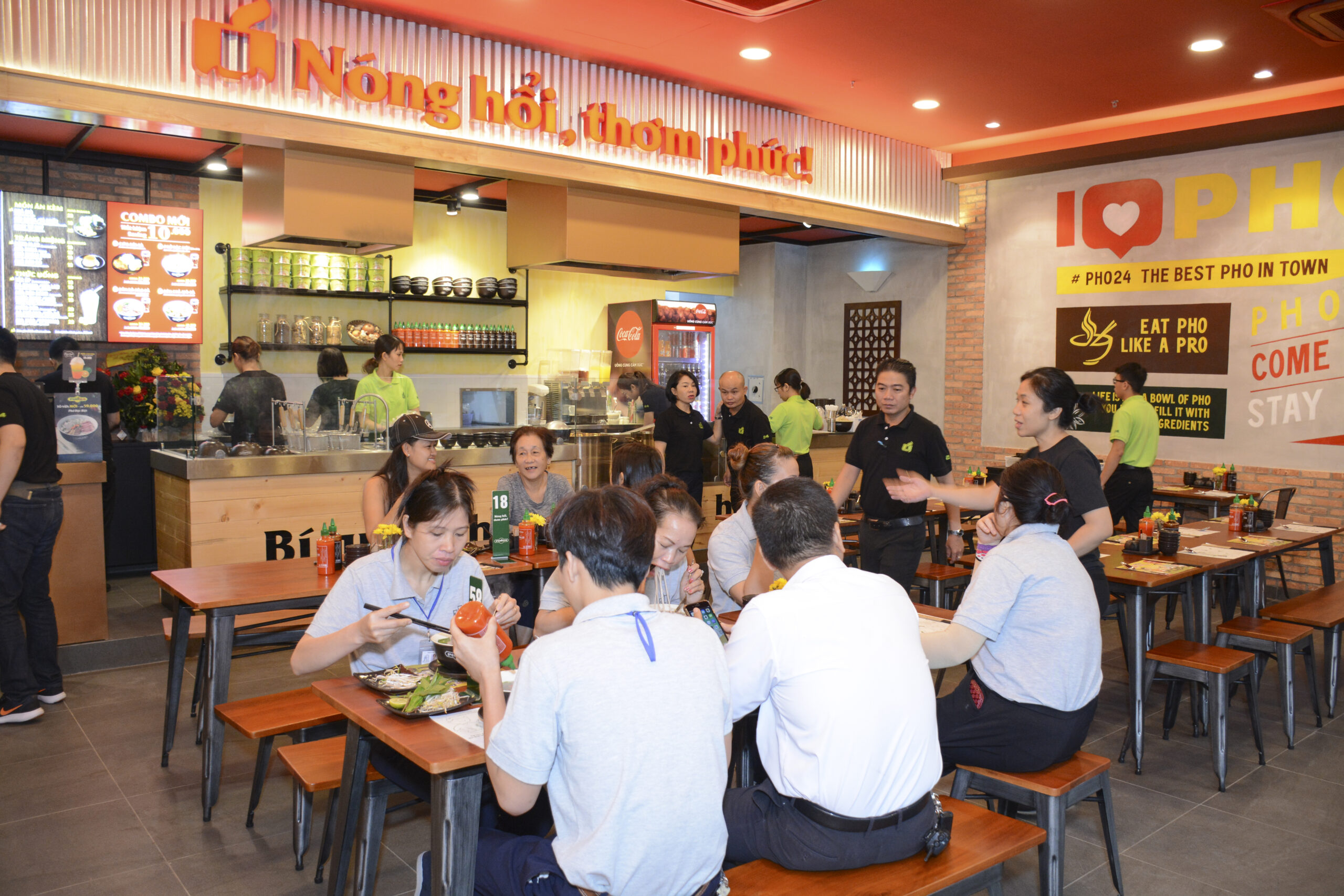
PHO24 runs a fast-casual format designed around how people actually eat in dense Vietnamese cities: complete meals delivered within minutes during peak hours, at an everyday affordable price point, in an environment tuned to modern urban life. Speed is not a marketing claim here; it is the operating constraint the whole model is engineered around, and it is what a central kitchen makes possible.
The menu is broader than the name suggests. Alongside pho, partners sell vermicelli noodles, rice dishes, beef stew, banh mi, spring rolls and side dishes, desserts and drinks. That range matters for daypart coverage — a single-dish concept concentrates demand into two narrow windows, while a multi-format menu earns revenue across breakfast, lunch, afternoon and dinner from the same rent. Investors comparing this against other formats will find the structural trade-offs laid out in our overview of QSR, fast casual and casual dining franchise formats across Asia Pacific and MENA.
| Function | Handled by the system | Owned by the franchise partner |
|---|---|---|
| Menu & recipe | Central factory production; fixed 24-ingredient broth specification | Nothing — no recipe development required |
| Supply chain | Authentic ingredient sourcing, competitive pricing, scheduled delivery | Ordering discipline and stock accuracy on site |
| Site selection | Advisory support on location assessment | Lease negotiation and landlord relationship |
| Training | Culinary, operations, food safety, staff management, cost control | Recruitment, retention and shift-level coaching |
| Technology | POS, inventory tracking, real-time reporting dashboards | Acting on the data the dashboards surface |
| Marketing | Grand-opening campaigns, social media, local promotion frameworks | Community presence and local execution |
| Quality | SOPs, quality audits, ongoing coaching and troubleshooting | Daily standards enforcement |
Read that table as a job description. The partner is not being asked to invent anything. They are being asked to run a tight floor, hold service times under pressure, and keep a team together — which is a different and, for most people, harder skill than cooking.
The brand’s stated partner profile is specific, and it is worth taking at face value rather than assuming any capable investor qualifies.
The common thread is presence. Central-kitchen formats reward operators who are physically close to the business, because the remaining variables — queue management, table turns, staff consistency — are all floor-level. Absentee ownership is the single most reliable way to underperform in this model.
PHO24 sits inside a broader shift. Vietnamese concepts have moved from single-city operations to structured, exportable systems within roughly a decade. East West Barbershop has passed 130 stores across five markets through international franchising, Viva Star Coffee entered Malaysia as its seventh overseas market, and Phúc Tea’s HappiTea is scaling across India toward 150 stores through a master partnership. Education has followed the same path, with English 1 now appointing a Vietnam development partner for its 60-year system.
What changed was not ambition but infrastructure: central production, documented SOPs and real reporting technology. Vietnamese cuisine is also the fastest-growing ethnic food category globally, which gives a pho system something most regional concepts lack — a category tailwind that does not depend on the brand explaining itself to new consumers.
In a fast-casual format built on speed and everyday pricing, the location decision carries more weight than almost anything a partner does afterwards. The maths is unforgiving: a high-frequency, moderate-ticket concept needs volume, and volume comes from catchment quality rather than clever operations.
Serious partners should treat site work as an analytical exercise, not an instinct. Catchment density, daytime versus residential population, competing dining supply, and access at peak hours all belong in the assessment before a lease is signed. Tools built for exactly this are now standard practice among multi-unit groups, as our profile of location intelligence across 23 Asia Pacific and MENA markets describes. The brand provides site-selection assistance, but the lease and the consequences belong to the partner.
The current mandate covers single-unit and multi-unit development. Choosing between them is a question about operator capacity rather than ambition. A single unit tests whether the partner genuinely enjoys the daily operating rhythm. A cluster of three to five restaurants in one city creates shared management overhead, easier staffing cover and a marketing spend that works harder — but it also demands a second layer of supervision the partner has to build and pay for.
Operators weighing larger structures should understand the differences between the available frameworks before entering discussions; we set these out in detail in our guide to master franchise, area development and joint venture structures. For most first-time partners, the honest answer is to earn the cluster rather than to buy it upfront.
PHO24 is not running an open sales process. VF Franchise Consulting acts as the exclusive franchise development advisor and conducts a structured review of candidates, with full investment information, territory detail and development economics released to qualified applicants. That sequencing is deliberate — it filters for operators who are evaluating a business rather than shopping a price.
Candidates who move quickly through review tend to arrive with three things ready: a clear statement of who will run the restaurant day to day, a realistic view of the city and catchment they want, and evidence of prior management responsibility. Those who stall usually cannot answer the first question. Our overview of how foreign and domestic brands register, structure and scale in Vietnam is useful background before that conversation, and the broader mechanics of securing multi-unit development rights for an Asian noodle concept illustrate how comparable processes run.
It is better suited to first-timers than most restaurant concepts, because the central factory removes culinary risk and the brand supplies training, SOPs, audits and reporting technology. The remaining demands — floor discipline, staffing, service speed — are learnable, but they require the owner to be present.
Standardisation. An independent pho shop depends on a cook; PHO24 depends on a documented specification produced centrally, delivered to each restaurant. That is what makes a second and third location realistic rather than a gamble on finding another good cook.
The active mandate covers Vietnam, for single-unit and multi-unit development with qualified owner-operators. Countries available beyond that are confirmed on qualification rather than published.
Investment, territory and development economics are not published. They are provided directly to candidates who pass the qualification review, which is standard practice for brands running a selective development process.
Training across culinary, operations, food safety, staff management and cost control; operational SOPs with quality audits and ongoing coaching; supply chain covering authentic ingredients and delivery; marketing support from grand opening through local promotions; site-selection assistance; and a technology stack covering POS, inventory tracking and real-time reporting.
PHO24 is a category leader in a cuisine that is expanding globally, wrapped in an operating model that was deliberately engineered for replication. The brand has done the hard part — taking the variability out of a dish that is notoriously hard to standardise. What it needs from a partner is the other half: someone who will be in the restaurant, hold the standards, and treat site selection as the decision that it is. Brand details and the company’s own partnership information are published on the official PHO24 franchising page.
Qualified operators considering the Vietnam mandate can request a strategic review through VF Franchise Consulting’s PHO24 brand page.